If you’ve asked “how much does the WhatsApp Business API actually cost in Malaysia,” the honest answer is: it depends on what you send, when you send it, and who you send it through. Meta charges per message, not per conversation anymore, and — starting 1 October 2026 — one of the categories businesses have relied on as “free” starts costing money for the first time. If you’re budgeting for WhatsApp messaging in Malaysia this year, that change alone is reason enough to get the numbers right.
This guide breaks down exactly what Meta charges, what your Solution / Tech Partners (like Seampify) adds on top, and what a realistic monthly bill looks like for a Malaysian SME.
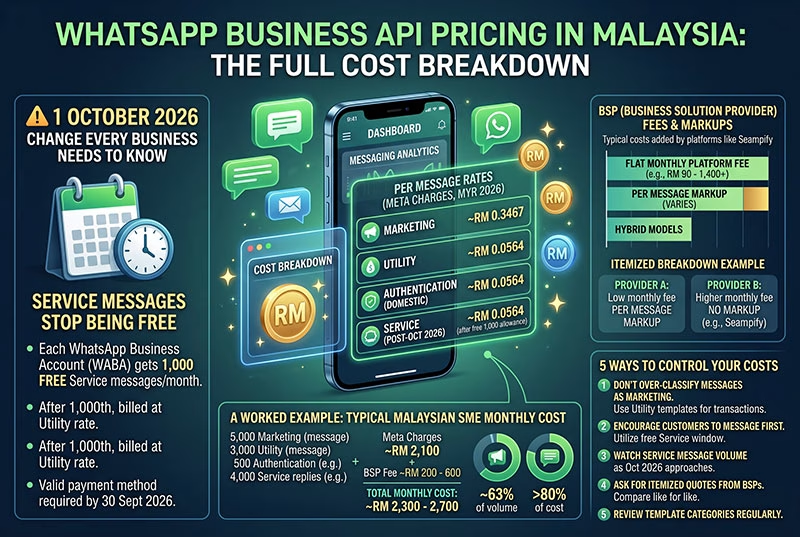
How WhatsApp Business API pricing actually works
Meta used to bill by the conversation — one flat fee covered a 24-hour window of unlimited back-and-forth messaging. That model was retired on 1 July 2025. Today, Meta charges per delivered message, and the rate depends on which of four categories that message falls into:
- Marketing — promotions, offers, re-engagement campaigns, or any message the customer didn’t directly ask for
- Utility — transactional, expected messages tied to something the customer already did (order confirmations, appointment reminders, delivery updates)
- Authentication — one-time passwords and login/verification codes
- Service — free-form replies sent within the 24-hour window that opens whenever a customer messages you first
Each category is billed at a different rate, and the rate also depends on the recipient’s country. Here’s what that looks like in Malaysia right now.
Malaysia rates: what Meta actually charges (2026)
| Category | Rate per message (MYR) |
|---|---|
| Marketing | ~RM 0.3467 |
| Utility | ~RM 0.0564 |
| Authentication (domestic) | ~RM 0.0564 |
| Authentication (international) | ~RM 0.1685 |
| Service (within 24-hour window) | Free — until 30 September 2026 |
A few things worth noticing:
- Marketing messages cost roughly 6x more than utility or authentication messages. If you’re using a marketing template for something that’s actually transactional (like a “your order has shipped” update), you’re paying six times what you need to. Getting your message categorization right is the single easiest way to cut your bill.
- Authentication messages sent to numbers outside Malaysia cost about 3x the domestic rate. This matters if you’re verifying customers who travel or hold foreign numbers.
- These are Meta’s rates only. Whatever platform you send through (your BSP) adds its own fees on top — more on that below.
The change coming on 1 October 2026: service messages stop being free
This is the part most Malaysian businesses haven’t budgeted for yet.
Since November 2024, Service messages — the free-form replies your team or chatbot sends within 24 hours of a customer messaging you — have been completely free, with no cap. That ends on 1 October 2026. From that date:
- Each WhatsApp Business Account (per phone number) gets 1,000 free service messages per calendar month. The allowance does not roll over.
- After the 1,000th message, every additional service message is billed at the same rate as a Utility message in that market — roughly RM 0.0564 per message in Malaysia.
- Utility messages sent within an open service window, which used to piggyback on the free conversation, are also now billed individually rather than bundled in.
- Meta requires a valid payment method on file by 30 September 2026, or message delivery may be interrupted from 1 October.
For context on scale: a business handling customer support for even a few hundred active WhatsApp conversations a day can burn through 1,000 free service replies well before the month is out. If your team currently treats WhatsApp support as a zero-cost channel, this is the moment to re-check that assumption — and to build a habit of watching your message volume rather than assuming it’s covered.
What your Solution (BSPs) / Tech Partners adds on top of Meta’s rate
Meta’s per-message rate is only half the bill. The platform you use to send and manage WhatsApp messages — your BSP — layers its own pricing on top, usually in one of three shapes:
- A flat monthly platform fee, sometimes with no markup on Meta’s per-message rate
- A per-message markup added to every message Meta charges for (commonly a few sen per message)
- A hybrid — a smaller monthly fee plus a smaller markup
Monthly platform fees among Malaysian and regional providers commonly range from roughly RM 90 to RM 1,400+, depending on features (number of agents/seats, automation flows, chatbot builder, CRM integrations, reporting) and message volume tier. Some providers also charge separate setup or verification fees (commonly RM 500–2,000), while others waive them.
The practical takeaway: two providers can quote wildly different-looking numbers and still cost the same in practice — one may advertise a low monthly fee but mark up every message, while another charges more upfront with zero markup. Always ask for an itemized breakdown that separates Meta’s pass-through cost from the provider’s own fee, so you’re comparing like for like.
For Seampify, we don’t mark up Meta’s charges — you pay Meta’s per-message rate exactly as shown above, plus our platform fee. See our pricing plan for the full breakdown.
A worked example: what a Malaysian SME might actually pay
Say a mid-size retail business in Malaysia sends, in a typical month:
- 5,000 marketing messages (promotions, campaign broadcasts)
- 3,000 utility messages (order and delivery updates)
- 500 authentication messages (OTP for account logins)
- 4,000 service replies to customers who message first (after Oct 2026 pricing applies, 1,000 free + 3,000 billed)
Rough Meta-side cost:
- Marketing: 5,000 × RM 0.3467 ≈ RM 1,734
- Utility: 3,000 × RM 0.0564 ≈ RM 169
- Authentication: 500 × RM 0.0564 ≈ RM 28
- Service (post-Oct 2026, after free allowance): 3,000 × RM 0.0564 ≈ RM 169
Estimated Meta charges: ~RM 2,100/month, before any BSP platform fee or markup is added. Add a typical BSP fee (say RM 200–600/month depending on plan) and you’re looking at an all-in cost somewhere around RM 2,300–2,700/month for this volume — a useful ballpark to sanity-check any quote you receive.
Note how marketing messages dominate the bill here — they’re 63% of message volume but over 80% of the Meta-side cost. That’s the lever worth pulling first.
How to control your WhatsApp messaging costs
- Don’t over-classify messages as Marketing. If a message is genuinely transactional — an order update, a reminder, a receipt — it should be a Utility template, not Marketing. This alone can cut a large chunk of most businesses’ bills.
- Encourage customers to message you first when possible. Replies inside an open service window are (for now, and even after October, up to your first 1,000/month) far cheaper than outbound marketing or utility sends.
- Watch your service message volume as October 2026 approaches. If your support team or chatbot handles high volumes, model what happens once free-form replies are billed and budget accordingly.
- Ask every BSP for an itemized quote. Separate Meta’s charges from the provider’s markup and monthly fee before comparing platforms.
- Review your template categories regularly. Meta occasionally re-classifies templates, and campaigns evolve — a periodic audit prevents costly drift.
Frequently asked questions
Is the WhatsApp Business API free to use?
No — as of July 2025, Meta charges per message for Marketing, Utility, and Authentication templates. Service (free-form) replies are free until 30 September 2026, after which the first 1,000 per phone number per month stay free and the rest are billed at the Utility rate.
How much does WhatsApp Business API cost per message in Malaysia?
Roughly RM 0.3467 for Marketing, RM 0.0564 for Utility and domestic Authentication, and RM 0.1685 for international Authentication messages (rates set by Meta and subject to change).
Do I need a BSP or Tech Partners like Seampify, or can I go directly through Meta?
Meta requires businesses to send API messages through an approved solution partners or its own Cloud API tooling. A tech partner like Seampify handles account setup, template approval, number verification, and provides the tools (broadcast, automation, reporting, CRM integration) needed to actually run WhatsApp at scale — Meta’s raw API alone isn’t a usable interface for most businesses.
Will my WhatsApp costs go up in October 2026?
For most businesses using WhatsApp mainly for customer support replies, yes — modestly, once you exceed 1,000 free service messages per number per month. Businesses that mostly send Marketing or Utility templates were already paying per message and won’t see a new cost category, though it’s worth re-checking your total volume either way.
Rates cited are Meta’s published per-message pricing for Malaysia and are accurate as of September 2026; Meta periodically adjusts rates by market, so confirm current pricing in WhatsApp Manager before budgeting. Talk to Seampify for a full cost breakdown tailored to your message volume.