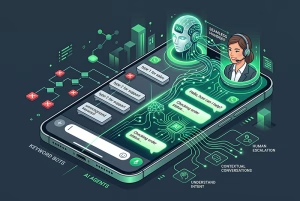
Chinese New Year is one of the busiest — and most competitive — promotional windows for beauty and wellness brands in Malaysia. Every spa, salon, and skincare brand is fighting for the same attention in the same two-week window, usually through the same email blasts and social posts everyone else is also sending. Here’s what a WhatsApp chatbot campaign can realistically do instead, based on published WhatsApp marketing benchmarks rather than guesswork.
The seasonal challenge
Going into CNY, a typical Malaysian facial spa, salon, or wellness business needs to:
Reach existing customers with a timely, festive promotion without it getting buried in crowded email and social feeds
Convert interest into actual bookings, not just likes or views
Do it at a scale the front-desk and customer service team can’t handle manually during the year’s busiest period
Email and social ads still have a role, but both compete for attention in channels that are easy to scroll past. WhatsApp starts from a structural advantage: people check it constantly, and a message there behaves more like a text from a friend than an ad.
The solution: a CNY WhatsApp chatbot campaign
A typical campaign built for this scenario includes:
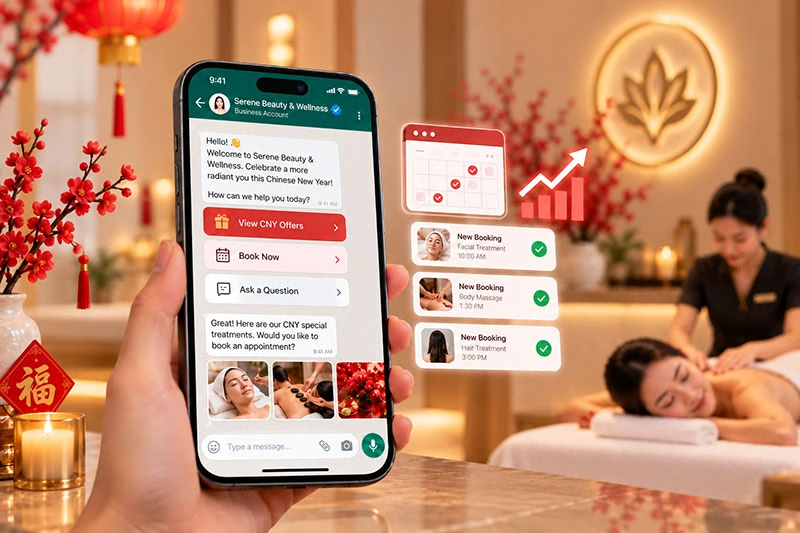
- A broadcast to the opted-in customer list announcing CNY promotions or gift sets
- An interactive menu (quick-reply buttons) letting customers browse offers, ask a question, or book directly — rather than linking out to a website
- Segmentation by past purchase or customer tier, so regulars and new customers see different offers
- An automated follow-up sequence for customers who don’t respond to the first message, timed a day or two later
- A handoff to a human agent (or direct calendar booking) once a customer is ready to commit
This is the same structure Seampify builds for seasonal campaigns generally — CNY, Raya, or year-end — because the mechanics don’t change much between occasions, only the offer and creative.
What results typically look like
These figures are published, cited benchmarks for WhatsApp marketing generally (see sources below) — not a specific client’s audited results. They’re a realistic range to set expectations against, not a promise.
| Metric | Typical WhatsApp benchmark | For comparison |
|---|---|---|
| Message open/read rate | ~98% technical delivery; 80–85% measurable open rate | Email: ~15–25% |
| Click-through rate (interactive button messages) | 45–60% | Email: 2–5% |
| Response rate (customer replies) | 45–55% | – |
| Conversion rate — broadcast campaigns | 3–7% | Email: 2–5% |
| Conversion rate — automated flows (e.g. follow-up sequences) | 10–25% | – |
| Revenue per recipient (e-commerce) | Roughly RM 9–28 per recipient (≈€2–6) | – |
Working through a small example: a business broadcasting a CNY offer to 3,000 opted-in customers, at a 5% broadcast conversion rate, would expect roughly 150 bookings or purchases directly attributable to that one campaign — before counting the additional conversions the automated follow-up sequence typically recovers from non-responders. That’s the kind of number worth modeling against your own customer list size before the campaign goes out, and it’s exactly the model to swap in real figures against once the campaign has actually run.
Why the mechanics matter more than the offer
A few structural choices tend to separate a campaign that converts from one that doesn’t, regardless of the actual promotion:- Interactive buttons outperform plain text links. Every extra tap or redirect loses people; a quick-reply menu keeps the whole interaction inside WhatsApp.
- Automated follow-ups matter more than the first message. A single broadcast catches only the people ready to act immediately — a follow-up a day or two later recovers a meaningful share of the rest.
- Segmentation avoids the “generic blast” feel. Existing customers and new leads respond to different offers, and treating them identically usually costs conversions on both sides.
- Timing follows behavior, not convenience. Sending when your customers are actually active (evenings and weekends tend to outperform working hours for consumer/beauty audiences) matters more than sending as early as possible.
Takeaways for other Malaysian SMEs
- Seasonal campaigns (CNY, Raya, year-end) are exactly where WhatsApp’s high open and response rates outperform email and social for time-sensitive offers
- A chatbot flow with clear next steps (book, browse, ask a question) converts better than a broadcast that just links out
- Automated follow-ups to non-responders typically recover conversions a one-and-done broadcast would miss entirely
Want to model what a campaign like this could do for your own customer list? Talk to Seampify.